
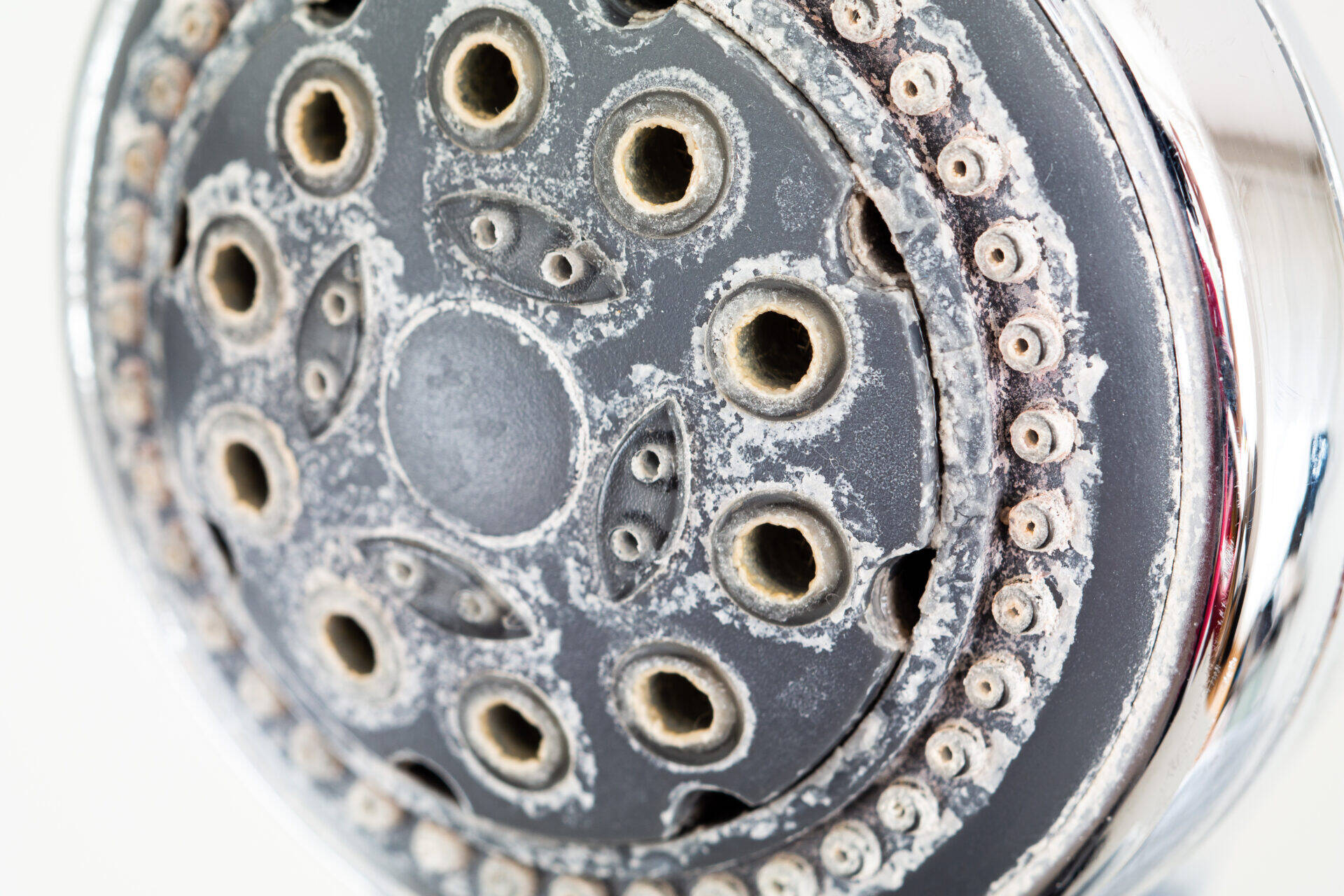
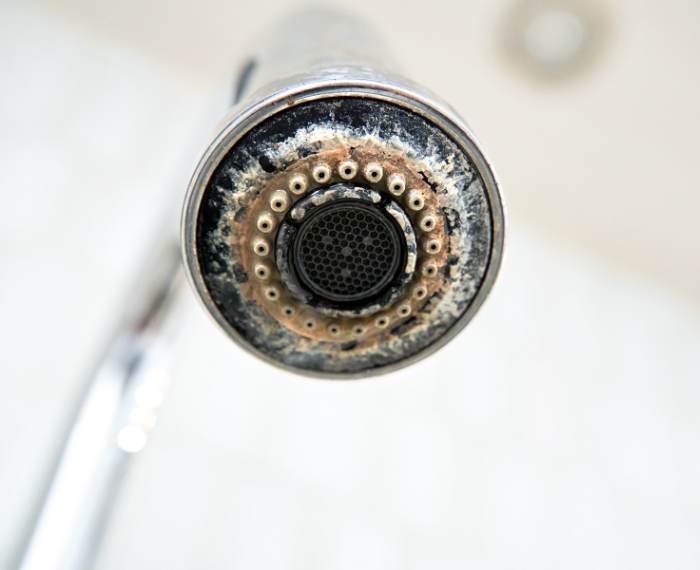
Electric shower limescale forms when hard water is heated on the shower’s element and the dissolved calcium carbonate drops out as scale. It blocks the head, makes the element run hot and can cut a shower’s life to a few years. Descaling the head helps, but treating the cold feed to the shower is the only lasting fix.
Key takeaways
- Water above 200 mg/l of calcium carbonate is classed as hard and will produce scale when heated. That covers most homes in London, the South East, the Midlands and the West Country.
- An electric shower heats cold mains water on a bare element in seconds, which is why scale builds inside the unit faster than almost anywhere else in the house.
- Every 1 mm of scale on a heating surface pushes energy use up by about 7%. A scaled element is also the usual reason an electric shower runs hot, cold or cuts out.
- A like-for-like electric shower replacement costs £350 to £750 installed, and manufacturers put the typical life at about five years in hard water.
- You can safely descale the shower head and hose with citric acid or white vinegar, but you should never open the shower unit or pour descaler into it.
- A whole-house Halcyan unit fitted on the incoming main costs £897 including VAT, needs no salt or power, and carries a 30-year warranty.
Contents
- What causes electric shower limescale?
- Can hard water damage an electric shower?
- What does electric shower limescale cost you?
- How to clean limescale from an electric shower: step by step
- How to stop limescale in an electric shower for good
- Best electric shower for hard water areas: what to look for
- Where Halcyan Water Conditioners fits in
- Frequently asked questions
- Get your shower protected
What causes electric shower limescale?
Electric shower limescale is a layer of calcium carbonate left behind when hard water is heated inside the shower. Hard water picks up calcium and magnesium as it passes through chalk and limestone. Heat makes those minerals come out of solution, and they settle on the hottest surface they can find. In an electric shower, that’s the heating element.
The Drinking Water Inspectorate notes that water at 200 mg/l of calcium carbonate or more will produce scale. Water companies use the bands below. If your postcode sits in the hard or very hard band, your shower is scaling up right now, whether you can see it or not. You can check your own area on our UK hard water map and postcode guide.
| Water hardness band | Calcium carbonate (mg/l) | What it means for an electric shower |
|---|---|---|
| Soft | Under 100 | Little or no scale on the element |
| Moderately hard | 100 to 200 | Slow scale build-up, mainly on the head |
| Hard | 200 to 300 | Scale forms inside the unit within months |
| Very hard | Over 300 | Heavy scale, early element failure likely |
Source: Southern Water hardness bands and the Drinking Water Inspectorate, checked October 2026.
Around 60% of mains water in the UK is classed as hard. Rinnai UK, which makes water heaters, puts the energy penalty at roughly 7% more energy for every 1 mm of scale on a heating surface. That figure applies to any element that heats water, including the one in your shower.
Can hard water damage an electric shower?
Yes. Hard water can damage an electric shower in three ways: it blocks the head, it insulates the element so it overheats, and it builds up on the moving parts. Triton Showers, one of the biggest UK makers, says scale inside the heater affects water flow, heater performance and internal parts over time.
The sequence usually runs like this. The shower head nozzles clog first and the spray pattern goes patchy. The element then scales up and runs hotter than designed, so the thermal cut-out trips and the water swings between hot and cold. If the head blocks badly, pressure builds inside the unit and the pressure relief device (PRD) blows. The PRD is a cheap part, but once it has gone the shower stops until it’s replaced.
Aqualisa, another major UK brand, says an electric shower can last upwards of five years with regular care, and most come with a two-year guarantee. In very hard water, scale is the main reason showers fall short of that.
What does electric shower limescale cost you?
The cost of electric shower limescale shows up in three places: a higher electricity bill, early replacement, and the time spent descaling. The replacement bill is by far the largest.
| Cost item | Figure | Basis |
|---|---|---|
| Running a 9.5 kW shower for 8 minutes | About 33p per shower | 1.27 kWh at 26.32p per kWh, Ofgem price cap, October to December 2026 |
| Extra cost with 1 mm of scale on the element | About 2p per shower, or £17 a year for two showers a day | 7% energy penalty per 1 mm of scale (Rinnai UK) |
| Like-for-like electric shower replacement | £350 to £750 installed | Mira Showers cost guide, April 2026 |
| Average supply and fit of a new unit | About £300 | Checkatrade figure, January 2025 |
| Replacing a shower every 5 years for 30 years | £2,100 to £4,500 | Six replacements at Mira’s installed price range |
Sources: Ofgem energy price cap unit rates, Rinnai UK on limescale and energy use, Mira Showers installation cost guide. Prices as of October 2026.
The energy figure looks small because a shower only runs for a few minutes. The real money goes on replacing a unit that should have lasted a decade. Part L guidance for England already recognises the problem for boilers. Where mains water hardness is above 200 ppm, the feed to water heaters and combi boiler hot water circuits should be treated to limit scale. An electric shower is a water heater too. It just rarely gets the same protection.
How to clean limescale from an electric shower: step by step
You can clean limescale from the parts of an electric shower that water leaves through, which means the head, the hose and the inlet strainer. You can’t clean the element, and you shouldn’t try. Here’s the safe routine.
- Switch the shower off at the pull cord or isolator and let it cool.
- Unscrew the shower head from the hose. Soak it for one to two hours in a bowl of warm water with two tablespoons of citric acid, or in neat white vinegar. Leave stubborn heads overnight.
- Rub the nozzles with your thumb or an old toothbrush, then rinse the head under the cold tap until it runs clear.
- Check the hose for lumps of scale by running water through it without the head on. Replace the hose if the flow is poor; a new one costs less than a tenner.
- If your shower has an accessible inlet filter or strainer, isolate the water, remove it as the manual shows, and rinse the mesh. Don’t force anything.
- Refit the head, turn the shower on cold first for a minute to flush loose scale, then run it on your normal setting.
- Repeat every one to three months in a hard water area. If the head blocks again within weeks, the scale is now coming from inside the unit and cleaning won’t keep up.
Full details for the head itself are in our shower head cleaning guide.
Can you descale an electric shower?
Only the outside. You can descale the head, hose and strainer, but the heater tank and element are sealed behind a cover with live electrical connections. Triton’s own guidance is clear: don’t remove the cover or inspect internal parts yourself. Pouring descaler into the unit can also damage seals and the element. If the unit itself has scaled up, a qualified installer can check it, but in most cases the honest answer is a new shower.
Tired of descaling every few weeks? Book a quick call with our Bristol team and we’ll tell you which unit protects your shower.
How to stop limescale in an electric shower for good
The only way to stop electric shower limescale is to treat the cold water before it reaches the shower. Cleaning deals with what has already formed. Anti-scale features in the shower slow it down. Treating the supply stops the element scaling in the first place.
| Option | What it protects | Upfront cost (inc VAT) | Running cost | Lasts |
|---|---|---|---|---|
| Regular descaling of head and hose | Head and hose only | Under £5 for citric acid | Your time, every 1 to 3 months | Until the next clean |
| Shower with phased shutdown and rub-clean head | Slows scale inside the unit | Built into a £75 to £500 shower | None | Life of the shower |
| Hose-fitted conditioner (Halcyan Personal unit) | Head, hose, skin and hair | £296 | None | 30-year warranty |
| Electrolytic or polyphosphate inline inhibitor | One appliance on that feed | About £14 to £17 for an electrolytic unit | Cartridge or unit replacement, life depends on water | Often 1 to 2 years |
| Salt-based water softener | Whole house, but needs a hard drinking tap | Several hundred pounds upwards, plus fitting | Salt and water for regeneration (about 17 litres and 300 g per cycle) | 10 years plus with servicing |
| Halcyan whole-house unit (H2o9) | Whole house, including the shower element | £897 | None | 30-year warranty |
Sources: Halcyan prices from halcyanwater.com, electrolytic inhibitor pricing from UK merchants, softener regeneration figures from Culligan Harveys. All as of October 2026.
Two things matter when you choose. First, where the device sits. Anything fitted on the hose treats water after it has left the element, so it protects the head and your skin, not the heater. To protect the element you need something on the cold feed to the shower, or on the incoming main. Second, what it does to the water. A salt softener removes the hardness minerals and adds sodium, so you can’t drink from a softened tap. A Halcyan conditioner changes how the minerals behave so they stay in the water as a soft, non-bonding powder rather than sticking as scale. The minerals stay in and every tap stays drinkable.
Do limescale filters for electric showers work?
They work for the head, not the heater. A shower filter screwed onto the hose can’t change what happens on the element, because the water has already been heated by the time it reaches the filter. Triton’s guidance also warns that any accessory between the shower and the head can restrict flow, so check your shower’s manual before fitting one. If the element is your worry, treat the supply instead.
Best electric shower for hard water areas: what to look for
The best electric shower for hard water areas is one with phased shutdown, a rub-clean head and an accessible inlet filter, fitted to a treated cold supply. No shower on the market is scale-proof, whatever the box says.
Here’s what the features actually do:
- Phased shutdown keeps cold water running for a few seconds after you switch off, flushing hot water off the element so less scale forms as it cools.
- Longer, more widely spaced elements (Mira calls its version Clearscale) run at a more even temperature, so there are fewer hot spots for scale to grip.
- Rub-clean silicone nozzles let you clear the head with your thumb instead of a soak.
- An accessible inlet strainer can be rinsed without opening the unit.
- A thermostatic model holds the outlet temperature steadier as scale changes the flow.
These features buy time. In water over 300 mg/l they don’t buy much of it. If you’re replacing a shower in London, Essex, Wiltshire or Dorset, where our customers see the heaviest scale, budget for supply treatment at the same time. It’s the difference between a shower that lasts five years and one that lasts fifteen.
Where Halcyan Water Conditioners fits in
Halcyan Water Conditioners is a British company based in Bristol that makes salt-free, chemical-free water conditioners for homes and businesses. The whole-house unit fits on the incoming main, usually next to the stop tap, and treats every tap, shower and appliance in the house from one point. There’s no salt, no electricity and no servicing.
The facts that matter for a shower:
- The H2o9 whole-house unit costs £897 including VAT and suits over 95% of UK homes. Larger properties use the H2o18 at £1,182.
- It takes up 25 cm of pipe, comes in 15 mm or 22 mm, and a plumber fits it in 30 to 60 minutes. Our installation guide and approved installer list cover the job.
- Every unit is WRAS approved for use with UK drinking water (certificate 2312081) and carries a 30-year warranty and a 12-month money-back performance guarantee.
- More than 3,000 units are fitted in UK homes, with a 96% customer satisfaction rate.
- Renters who can’t cut into the main can fit the Personal shower unit to the hose in 30 seconds for £296. It protects the head, hose, skin and hair, though not the element inside the shower.
Not sure which size you need? Use the size guide, or read how the Halcyan system works. If you want a direct comparison with salt softeners, see water softener vs water conditioner.
One honest caveat. A Halcyan doesn’t make water feel 100% soft in the way a salt softener does, and you’ll still see a light powder on surfaces that wipes off easily. What it does is stop scale bonding to your shower element, your boiler and your taps, for decades, with nothing to top up.
Frequently asked questions
Can you descale an electric shower?
You can descale the head, hose and inlet strainer, but not the heater tank or element. Those sit behind a cover with live electrical connections, and manufacturers say not to open it. Pouring descaler into the unit can damage seals. If scale inside the unit is causing hot and cold swings, ask a qualified installer to check it.
How long should an electric shower last in a hard water area?
About five years is typical in hard water, according to Aqualisa, with a two-year guarantee as standard. Scale on the element is the usual cause of early failure. With the cold supply treated, there’s no reason an electric shower shouldn’t reach ten years or more, because the element stays clean.
Do limescale filters for electric showers work?
Hose-fitted filters protect the head and your skin, not the element, because the water has already been heated by the time it reaches them. Some can also restrict flow, which electric showers are sensitive to. To protect the heater you need treatment on the cold feed or the incoming main, such as a whole-house conditioner.
Is there a best electric shower for limescale?
Look for phased shutdown, a rub-clean head, an accessible inlet strainer and thermostatic control. Mira, Triton and Aqualisa all offer models with these features. None of them is scale-proof in very hard water above 300 mg/l. The feature that helps most is fitting the shower to a treated supply.
Do I need a water softener for an electric shower?
Not a salt softener specifically. You need something that stops scale forming on the element, which means treating the cold feed. A salt softener does that but needs salt, space and a separate drinking tap. A Halcyan whole-house conditioner does it with no salt, no power and no maintenance, for £897 fitted in under an hour.
How do I find the water hardness in my area?
Enter your postcode on your water supplier’s website, which gives the figure in mg/l of calcium carbonate. Anything over 200 mg/l counts as hard. Our hard water map covers the main regions, and most of London, the South East, the Midlands and the West Country sit in the hard or very hard bands.
How often should I descale my shower head?
Every one to three months in a hard water area, or as soon as the spray pattern goes uneven. Soak the head in citric acid solution or white vinegar for one to two hours, rub the nozzles and rinse. If it blocks again within weeks, scale is coming from inside the unit and cleaning won’t keep up.
Does the Halcyan Personal shower unit protect the heating element?
No. The Personal unit screws onto the shower hose, so it treats water after it has left the element. It protects the head, hose, skin and hair, and it’s ideal for renters. To protect the element inside an electric shower you need the whole-house H2o9 unit fitted on the incoming main before the shower.
Is it safe to put vinegar through an electric shower?
Vinegar is safe for the head and hose, but never pour it into the shower unit itself. Acid can attack seals and the element, and the unit contains live electrical parts. Clean the head and hose separately, then run the shower on cold for a minute to flush any loose scale through before using it normally.
Why is limescale coming out of my electric shower in lumps?
Lumps mean scale has built up on the element and is now breaking off as it heats and cools. It’s a sign the inside of the unit is heavily scaled. Cleaning the head will clear the blockage for a while, but the lumps will keep coming until the supply is treated or the shower is replaced.
Get your shower protected
Electric shower limescale is not something you have to keep scrubbing at. Halcyan Water Conditioners, based in Bristol, can tell you in one short call which unit suits your home and how quickly a local installer can fit it. Call us on 0345 504 0656, email [email protected], or send us a message through the contact page.