
Do water softeners waste water? The numbers, in the driest July on record
The short answer: yes, a small amount, every time they clean themselves. For a family home it adds up to somewhere between 5,000 and 7,000 litres a year, along with close to 100kg of salt. Those figures come from softener manufacturers’ own published specifications, not from us. Whether that matters is a fair question, and in a drought summer, we think it does.
Where England’s water is right now
At the end of July 2026, the Environment Agency declared drought across seven regions, covering more than half of England. July is on track to be the driest on record: the country received around 7% of its normal rainfall for the month, and parts of southern England received roughly 1%.
Around 40% of England’s population is now under a hosepipe ban. Around 78% of English rivers are running below normal flow, and 17% are classed as exceptionally low. The Environment Agency has carried out dozens of fish rescue operations this year, moving trout, juvenile salmon and other species out of watercourses where oxygen levels and flows had fallen to critical points.
That is the backdrop. Now to the utility cupboard.
How a Salt Water Softener Actually Works
A conventional water softener is an ion exchange unit. Your mains water passes through a cylinder of resin beads. Those beads hold sodium, and as the water flows past, they swap the calcium and magnesium that cause hardness for that sodium. The water that comes out the other side is soft.
The beads have a finite capacity. Once they are loaded with calcium and magnesium, they stop working, and the unit has to reset itself. It does this by flushing the cylinder through with a concentrated salt solution, which drives the hardness minerals off the resin and recharges it with sodium. The resulting mixture is salt, dissolved hardness minerals and rinse water, going to the drain.
This is called regeneration. It happens automatically, on demand or on a timer depending on the unit, and for most people it happens overnight. You do not see it, you do not hear it, and nothing on the machine tells you it has happened.
The Numbers
Culligan Harveys are the best-known name in British water softening, and to their credit they publish their operating figures openly on their own website. A good deal of the industry does not. So the numbers below are theirs.
On their FAQ page covering regeneration, they state that around 402 litres of water flows through the softener between regenerations, and that 17 litres of water are used in the regeneration process. They add, in their own words, that installing a water softener will slightly increase your water use.
Their product literature gives the same figure for the HarveyArc and Minimax units, 17 litres of water and 300g of salt per regeneration. Their larger HVX model uses 37 litres of water and between 0.9kg and 1.3kg of salt per regeneration.
For comparison, Scalemaster publish 18 litres and 330g for their SL150 non-electric unit. So 17 litres is not an outlier figure, it is roughly what a well-designed, non-electric, demand-regenerating softener uses. Timer-based electric softeners, which regenerate whether they need to or not, generally use more.
What That Adds Up To Over a Year
Take a family of four putting around 350 litres a day through the softener. That is 127,750 litres a year. Divided by 402 litres between regenerations, that is roughly 318 regenerations. At 17 litres each, that is 5,400 litres of water a year to the drain, and at 300g each, around 95kg of salt.
Culligan Harveys’ own water efficiency calculator page works from five occupants using 120 litres a day, with 520 litres between regenerations at 315ppm hardness. That gives around 421 regenerations a year, roughly 7,160 litres and 126kg of salt.
So: 5,000 to 7,000 litres a year is a reasonable, conservative range for a typical family home. That is sixty to ninety bathfuls. Larger households, harder water and larger units all push it up.
Why You Cannot Put Softened Water on The Garden
Gardening is the part that catches people out, and it matters more in a hosepipe ban than at any other time.
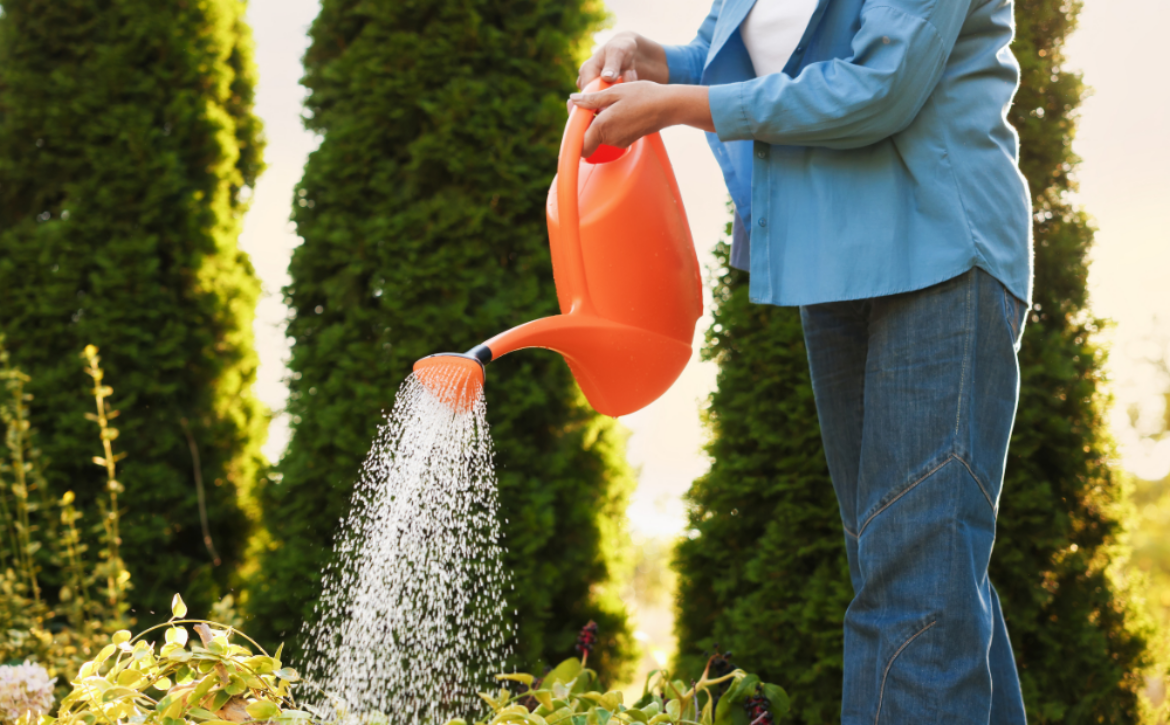
During water restrictions, plenty of us start saving washing-up water and bath water for the garden. It is sensible, it is permitted, and it keeps things alive. But if your water has been through a salt softener, it carries a meaningful sodium load, and salt causes problems for plants in three separate ways.
It makes water harder to take up. Salt in the soil raises the osmotic pressure around the roots, so plants have to work harder to draw water in. The practical effect is that a plant can show the classic drought symptoms of wilting and dropping leaves in soil that is visibly damp.
It accumulates in the plant. Salt taken up through the roots concentrates in leaf tissue, particularly at the tips and margins. That is what produces the scorched, brown-edged look you see on salt-stressed plants.
It degrades the soil. Sodium breaks down the crumb structure of soil, causing clay particles to disperse and the soil to compact. Compacted soil holds less water and drains badly. In other words, repeated watering with softened water makes your soil worse at doing the one thing you most need it to do in a drought.
So the greywater goes down the drain instead, in the driest summer on record.
Where The Salt Ends Up
Regeneration water goes into the foul drain and on to the sewage treatment works. Those works are designed to remove solids, organic matter and nutrients such as nitrogen and phosphorus. They are not designed to remove dissolved salt, and they do not. Salt passes straight through the treatment process and out with the treated effluent into the receiving watercourse.
In a normal year the river dilutes it and nobody notices. But dilution is essentially the only defence a river has against a soluble pollutant, and at the moment there is very little water available to do the diluting. When 78% of English rivers are below normal flow and 17% are exceptionally low, the same quantity of salt entering a much smaller volume of water arrives at a higher concentration, reaching fish and freshwater invertebrates that are already dealing with low oxygen and high temperatures.
A single household’s contribution to that is genuinely small. But it is also, unlike most of the pressures on our rivers, entirely optional.
What This Does Not Mean
We would rather be useful than persuasive, so here are the honest limits of the argument.
Softeners are not badly engineered. 17 litres per regeneration is a genuinely efficient figure, and non-electric demand-based regeneration is a sensible design that wastes far less than timer-based alternatives. The industry has worked hard on this.
Domestic softeners are not the main source of salt in rivers. Road de-icing salt, industrial discharge and agricultural runoff are all substantially larger contributors. Nobody should read this and conclude that softeners are why our rivers are struggling.
A softener does something HALCYAN does not. A salt softener genuinely removes hardness minerals from your water. That is why softened water lathers differently and feels different. HALCYAN does not remove those minerals but rather changes the way they behave, so that scale does not form and adhere in the way it otherwise would. If your priority is the feel of softened water, a softener does that and we do not.
HALCYAN will not reduce your metered water use. We are not a water-saving device. What we can say is that we do not spend any water in order to work, and we do not make the water you have already used unusable.
The Alternative, Briefly
HALCYAN is a passive alloy water conditioner. It fits into your pipework near the stopcock, usually in under an hour, and then it does nothing that requires your attention ever again. No electricity, no salt, no regeneration cycle, no discharge to drain, no maintenance. It dramatically reduces limescale and removes existing build-up over time.
Because it does not change what your water is made of, the water leaving your taps is chemically the same water that entered your home. Which means the washing-up bowl and the cooled bath water can go on the beds and the pots — mild detergents, off the edibles, and alternated with rainwater where you can manage it.
It costs £897 including VAT, comes with a 30-year warranty and a 12-month money-back guarantee.
Sources
- Culligan Harveys, “How much water flows through the softener in between regenerations?” — 402 litres between regenerations, 17 litres per regeneration. https://www.harveywatersofteners.co.uk/faq/how-much-water-flows-through-the-softener-in-between-regenerations/
- Culligan Harveys, “Water Softener Regeneration: How It Works and Why It Matters” — same figures restated. https://www.harveywatersofteners.co.uk/regeneration/
- Culligan Harveys, water efficiency calculator guidance — 520 litres between regenerations at 315ppm, occupancy assumptions. https://www.harveywatersofteners.co.uk/faq/how-do-i-fill-water-softeners-section-water-efficiency-calculator-governments-code-sustainable/
- Culligan Harveys, “What actually happens when you soften water by ion exchange?” — description of the ion exchange process. https://www.harveywatersofteners.co.uk/faq/what-actually-happens-when-you-soften-water-by-ion-exchange/
- Culligan Harveys product brochure — HarveyArc 17L / 300g; HVX 37L / 0.9–1.3kg per regeneration.
- Scalemaster SL150 non-electric water softener technical data sheet — 18 litres, 330g per regeneration.
- Environment Agency drought declaration, 29 July 2026, and the weekly “Dry weather and drought in England” reports on gov.uk for rainfall, river flow and reservoir figures.